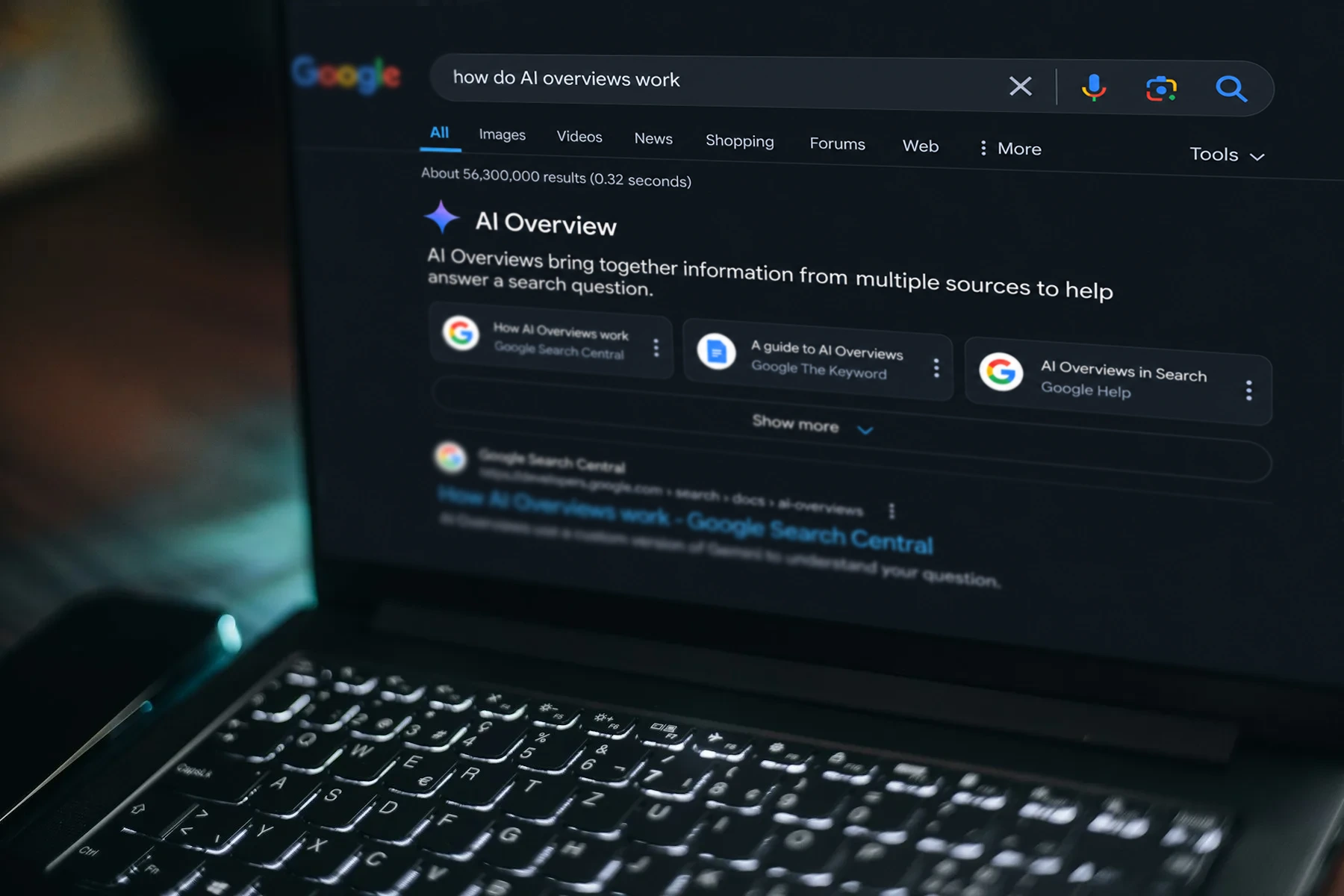
When the answer arrives before the visit, the website needs to earn the next decision.
The answer can arrive before the visit
A prospective customer asks a question, reads an answer, and moves on. Your company may have helped inform that answer without receiving a visit. For a business accustomed to treating search visibility and website traffic as roughly the same thing, that changes the planning problem.
Pew Research Center analyzed 68,879 Google searches from 900 U.S. adults in March 2025. Users clicked a traditional result in 8% of visits with an AI summary, compared with 15% without one. Links inside the summaries received clicks in just 1% of visits where a summary appeared.
That is a dated observational study, not a forecast for every business or proof that AI caused any particular traffic decline. Query types differ, and search experiences keep changing. It is still a useful warning: being present in a search result does not ensure that the reader will leave it.
A zero-click search is one that ends without a click through to an external website. Sometimes that means the person got a useful answer. Sometimes they reformulated the question or stopped looking. Those behaviors have different commercial meanings, even when they produce the same empty space in your analytics.
AIEO should make the business easier to understand
AI Engine Optimization, or AIEO, is a useful working label for improving how answer engines understand and represent a business. You will also encounter AEO, for answer engine optimization, and GEO, for generative engine optimization. The names matter less than the work they describe.
Google’s current guidance treats optimization for its generative search features as part of SEO. It emphasizes useful original content and a sound technical foundation; it does not require special AI schema or an llms.txt file. Eligibility includes indexing, snippet eligibility, and inclusion in generative AI features through Search Console. None of that guarantees a citation.
For a business owner, the useful shift is to ask what a prospective customer should understand before arriving. Which problems do you solve? Who is a good fit? What evidence supports the claims? What limitations would change the recommendation?
A practical AIEO program makes those answers clear, consistent, and supportable. It also gives the person a reason to continue to the website when the decision requires more than a summary.
The website needs to help a customer make a decision that a summary alone cannot settle.
Give people something worth following to the source
A generic explanation of your industry is easy to summarize. A useful piece of decision support gives a reader something they can apply: an honest comparison, a worked example, a clearly bounded offer, or evidence that helps them judge whether a solution fits.
Consider a hypothetical commercial service company. A page saying it delivers quality service adds little to a buying decision. A page explaining the conditions it handles, how an assessment works, what changes the scope, and when it recommends another provider helps a buyer ask better questions.
The same principle applies to a consulting practice. A prospect comparing a website refresh with a deeper operational change needs to understand the difference in problems, responsibilities, and expected work. A glossary entry cannot carry that decision. A careful explanation can.
This is an editorial recommendation, not a claim about a secret ranking factor. Build pages that remain useful even if no answer engine ever cites them. That is a stronger investment test than whether a paragraph sounds optimized for AI.
Make the evidence maintainable
Publishing a claim creates an ongoing responsibility. A case study can outlive the conditions behind its result. A service description can promise a capability the team no longer offers. An old comparison can quietly become misleading.
Assign an owner to the pages that influence important buying decisions. Keep source material for material claims, explain the scope behind results, and record when the substance was last reviewed. Do not change a date merely to make an old page look fresh.
Write the answer clearly enough that a reader can tell what is known and what depends on their circumstances. Place qualifications beside the claim they limit. If a result came from one engagement, say so; if an example is hypothetical, label it.
Consistency also matters operationally. Your website, sales materials, and public business information should describe the same offer. When they disagree, fix the underlying definition of the service before producing more content about it.
Diagnose the decline before changing the strategy
A drop in organic traffic deserves investigation. It does not, by itself, establish that AI summaries caused the problem. A broken page, changed demand, weaker visibility, seasonal behavior, or a measurement issue can produce a similar chart.
Start with the pages and queries where the change is concentrated. Compare impressions, clicks, and click-through rate over comparable periods. Then check whether the decline reached qualified inquiries, booked conversations, sales, or the other outcomes the website exists to support.
A page can lose casual informational visits while continuing to bring valuable prospects. Another can hold its traffic while losing the people most likely to buy. Those cases require different decisions. One aggregate traffic number hides that distinction.
Use a small scorecard:
- Discovery: Relevant search visibility and observed representation of the business in a fixed sample of buyer questions.
- Visits: Search clicks and identifiable referrals, separated by the pages and needs they serve.
- Demand: Qualified inquiries and the proportion that advance to a useful conversation or purchase.
- Business value: Revenue, fit, and the cost of handling demand, where those outcomes can be measured responsibly.
Treat AI visibility as evidence with limits
Testing a few prompts can reveal whether an answer engine misunderstands your offer, cites an outdated page, or omits a qualification. It cannot prove your market share of AI attention.
Keep the questions, date, engine, and observed result together. Repeat a consistent sample over time and record changes. A citation is an observation; a missing citation is another observation. Neither establishes what every prospective customer saw.
Ask new customers how they found you and what helped them decide, while accepting that recall is imperfect. Read those answers alongside measurable referrals and commercial outcomes. Do not turn unattributed demand into an invented AI conversion total.
The purpose of the review is to find correctable gaps. If an answer misstates a service boundary, improve the authoritative page and check the result later. If it gets the facts right but the website fails to help the visitor act, improve the buying journey.
Start with one consequential customer decision
For the next month, choose one question that repeatedly appears before a good customer buys. Review the page that should answer it and the evidence behind its claims. Talk to the people who handle those inquiries. Identify what a reader needs to know to make progress.
Revise that page around the decision. Explain the offer, the fit, the tradeoffs, and the next step. Add only the examples and evidence you can stand behind. Confirm that the page can be discovered and read, then establish a baseline for both visits and useful demand.
After release, review what changed and what remains uncertain. Expand the work when the evidence gives you a reason to do so. Avoid filling the site with near-identical answers simply because a tool can generate them.
When a search engine answers a basic question without sending a visitor, the business still needs to earn the next decision. A clear, credible website helps someone move from information to judgment—and from judgment to a conversation worth having.